| |
KUNIYOSHI(1797 - 1861)"Springtime Hustle and Bustle" |
"Springtime Hustle and Bustle"
("Haruno ni giwa hi āchisuto", "春のにぎわひ")
1845 - 1848
("Haruno ni giwa hi āchisuto", "春のにぎわひ")
1845 - 1848
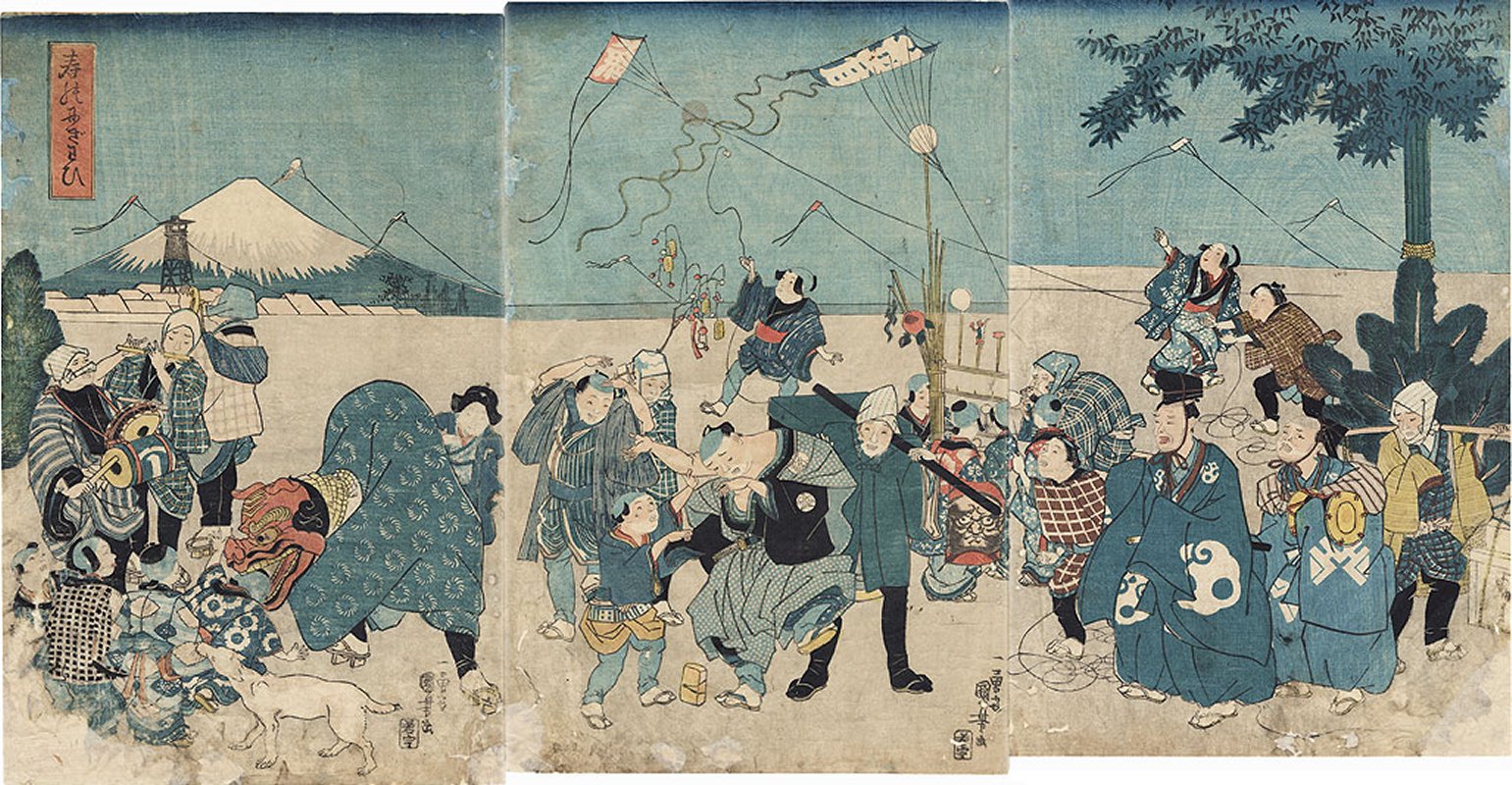
Comment - The tryptich shows a lively
scene with all it's hustle and bustle during the springtime
festival on New Year's Day. The scene is framed by Mount Fuji
on the left panel, with a row of rooftops, and an emerging
firetower. A red Edo kite
(edo tako, 江戸凧) on
the left slope in the far behind the watchtower,
and a white octopus kite
(takotako; 鮹凧 'or' たこカイト) in the far distance on the
right slope of Mount Fuji. On the right rim of the right panel
is a large kadomatsu
tree. The right panel in front shows the master of a house. He
is dressed in formal kamishimo attire and a black hat. His
face looks, as if he is completely drunk from the toso (spiced
sake) he had at the beginning of the new year celebration.
Behind him his apprentice carries a drum. A servant beind the
apprentice carries a box with liquor on a shoulder pole. The
apprentice and the servant both are showing worried faces. Two
boys directly behind the master are engrossed in flying a red
edo kite with white kanji.
Left to the master, another boy is handling an edo kite
standing on the ground. The kite shows a grim Daruma face. The kite line
of the Daruma kite curls on the ground in front of the
kamashimo wearing master's sandals. Directly behind the daruma
edo kite are four children with blue caps, gathered in front
of a toy vendor rack. Right to the rack is a flute blowing
comedian with a head scarf. Left to this group is a vendor
with a large box, carried with a black shoulder pole.
The center shows Mikawa Manzai performers, namely Tayu and Saizo. Mikawa Manzai is a traditional Shinto traditional comedic style, with performers who go from house to house, singing and dancing to the drumming of the saizo. Wishing tree twigs emerge from behind. Abaft this group is a boy, holding a nearly curling kiteline in his right hand. His far away kite is just falling down.
The left panel shows a lion dance performance accompanied by flute and drum players on getas. The geta wearing lion dance performer pretends biting one of the children's heads. The lion performer's helper is standing beind, and is smiling at the scene. The dog in the foreground is looking up at the children. A small kadomatsu frames the left rim of the left panel.
Upper left of the left panel shows the red title cassette.
The large blue edo kite with the white kanji and the long tail ropes in the center panel, and the red edo beaneth it, seem not to be attributable to any of the kite-flying children. The right panel shows two other edo kites in the far distance.
Series - ~
Artist - see Biography
Signature - Ichiyûsai Kuniyoshi ga (一勇斎国芳画) on all three panels lower right, the signature of the right panel is hidden in the restored cut-off lower edge
Publisher - Wakasa-ya Uhei (若狭屋右兵衛) by Wakau seal (若宇) lower left to KUNIYOSHI's signature
Image Size - 36.8 x 72.4 cm (14 1/2" x 28 1/2")
Condition - triptych; nishiki-e (cloured woodblock); Vertical ôban (ôban tate-e); panels restorated and presumably partially cropped
The center shows Mikawa Manzai performers, namely Tayu and Saizo. Mikawa Manzai is a traditional Shinto traditional comedic style, with performers who go from house to house, singing and dancing to the drumming of the saizo. Wishing tree twigs emerge from behind. Abaft this group is a boy, holding a nearly curling kiteline in his right hand. His far away kite is just falling down.
The left panel shows a lion dance performance accompanied by flute and drum players on getas. The geta wearing lion dance performer pretends biting one of the children's heads. The lion performer's helper is standing beind, and is smiling at the scene. The dog in the foreground is looking up at the children. A small kadomatsu frames the left rim of the left panel.
Upper left of the left panel shows the red title cassette.
The large blue edo kite with the white kanji and the long tail ropes in the center panel, and the red edo beaneth it, seem not to be attributable to any of the kite-flying children. The right panel shows two other edo kites in the far distance.
Series - ~
Artist - see Biography
Signature - Ichiyûsai Kuniyoshi ga (一勇斎国芳画) on all three panels lower right, the signature of the right panel is hidden in the restored cut-off lower edge
Publisher - Wakasa-ya Uhei (若狭屋右兵衛) by Wakau seal (若宇) lower left to KUNIYOSHI's signature
Image Size - 36.8 x 72.4 cm (14 1/2" x 28 1/2")
Condition - triptych; nishiki-e (cloured woodblock); Vertical ôban (ôban tate-e); panels restorated and presumably partially cropped
Copyright 2008 ff: Hans P. Boehme